By John Chmaj
Monet built his garden at Giverny late in the 19th century and painted aspects of it almost continuously until his death in 1926. Each painting is its own reflection (no pun intended) on colors, depth and the joint experience of earth, land and sky.
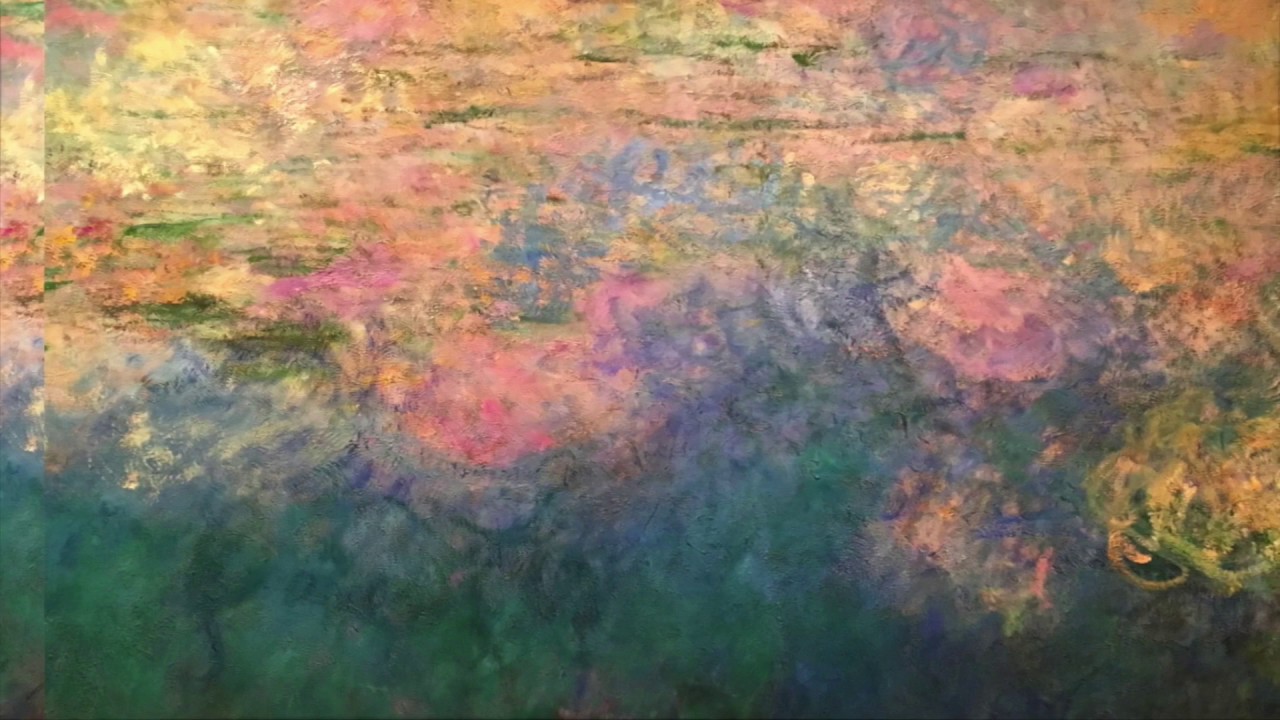
The painting is a flow of whites to greens, to blues, deeper and deeper into the pond until back up to the lighter green lilies (right to left)
The sky is a series of indistinct, bright white swirls, reflections of clouds in the water. The lilies floating on top are reduced to darker outlines, shadows passing across the clouds
The water has tendrils and ripples pushing the eye downward, drawing the eye from the clouds into progressively deeper tonal ranges of green and blue. This journey ends in the dark lower left regions of the painting, a muddy, indistinct area.
During the journey to the left the eye has traveled across the clearest set of lilies. Once its tonal journey is complete to black (the antithetical resolution of the white at upper right) the eye now hones in on the lilies. These are now explored in perspective, moving up to the left – they float in space on the canvas, a separate layer of shapes and color splayed upwards and away to the leftmost corner. We grovel in the leftmost side of the painting for a bit, in the mud and leaves.
Finally, the eye pulls back and sees the relations and motion of the whole – how the clouds introduce the theme of the lilies, which themselves suggest a motion to the left, across a tonal journey from lighter greens to darker blues. We can also see the lilies clustered lower left balancing the clouds upper right, and finally interpret the 3-dimensional aspects of the sky, lilies, water and bottom, all the layers at once implied by the arrangement of colors and shapes.
If we want, we can return our perception to pure abstraction as well – once the mind has done its job of interpreting the shapes and relationships, it is free to relax and enjoy the expressiveness of the color palette as a whole, also to enjoy the overall calm and relaxed nature of the composition, and pass a few moments ‘on the pond’, at one with the simple clarity and Zen-ness of it all.
A fitting musical form for this experience is Blue in Green, composed by Bill Evans for Miles Davis’ Kind of Blue album. This gentle, cyclical form has just the loose, textural gestures that give a sense of gentle motion but without conclusion. Improvisational approaches include
Slow pan L to R, with each layer slowly, continuously undulating:
• Lilies
• Deep blue bottom
• Sky
• Purples and Greens
Improvisation can evolve as the sections emerge in the panorama
Section 1: The Sky
Section 2: The water
Section 3: The lilies
Section 4: The whole
There is something timeless and eternal about both the musical piece and the painting. Lilies, clouds and ponds don’t “go” anywhere – they arise, float, and fade. In this way the painting and the music seem to cut a small slice out of the eternal, and invite us to linger a while.